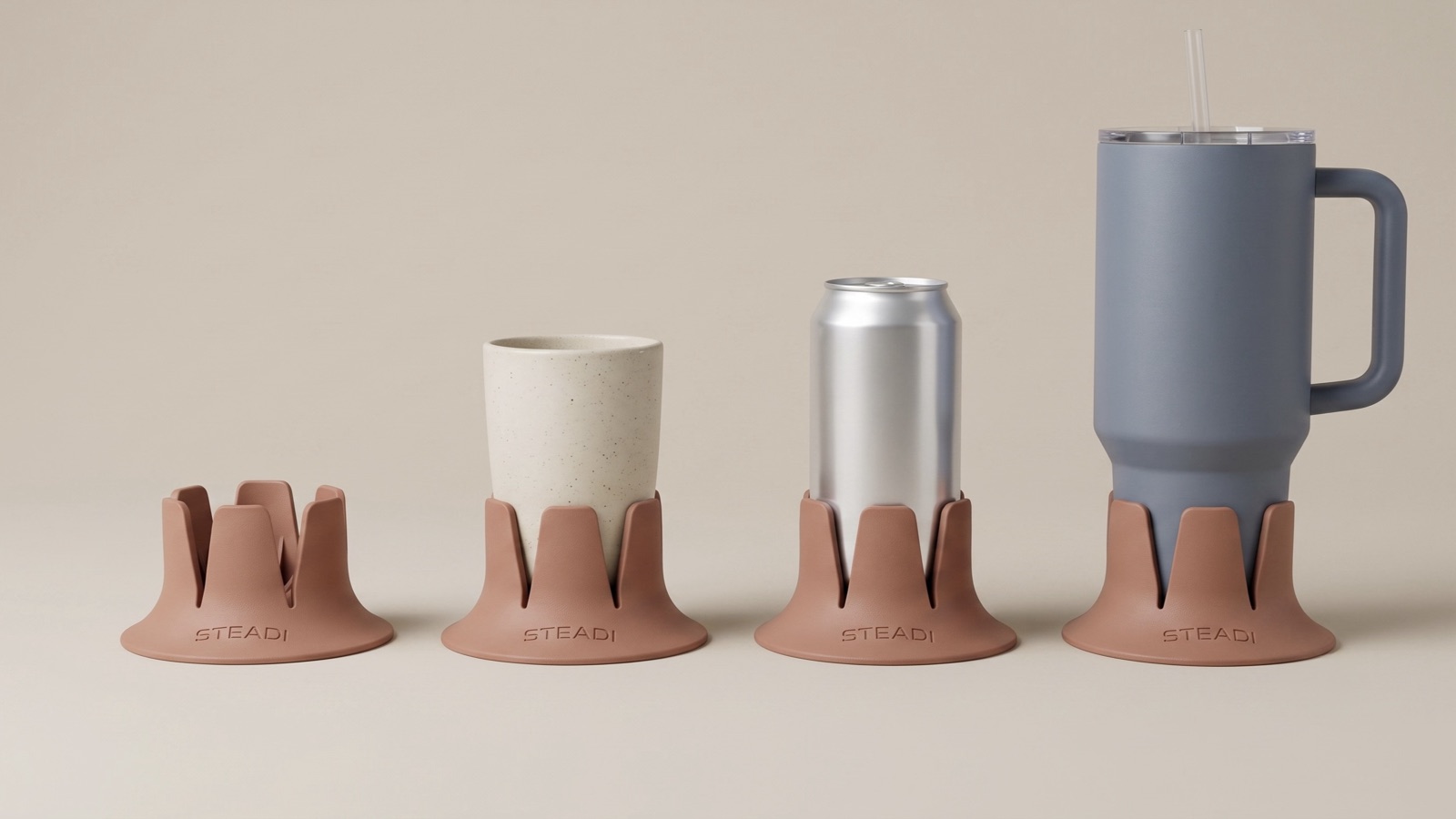
Finally, somewhere to put your drink, whatever your seat came with.
A flexible base that holds your cup, can, or tumbler steady on the seat, the footboard, or the concrete step beside it — hard, flat stadium surfaces are exactly what it's built to grip, holder or no holder. For the fountain drink that showed up with no holder in sight, the 40 oz tumbler too wide for the one that did, and the beer you'd rather not explain to the person sharing your armrest.
The base at work. Empty, then a cup, a can, and a 40 oz tumbler — the same grip whether your section got a holder or not.
The problem, named
Whether you got a cup holder depends entirely on which ticket you bought.
Some sections have a molded ring built into the armrest. Most bleacher and grandstand rows have nothing at all — and even a 'yes' from the seating chart usually means a ring sized for a cup half the size of the one in your hand.
The armrest ring, if your section has one.
A single molded plastic loop, shared ambiguously between two seats and bulk-ordered as whatever holder is cheapest for the hardware spec. It was sized for a standard fountain cup, so a souvenir cup or a 40 oz tumbler doesn't sit in it — it perches on top, waiting for an elbow.
The footboard, if you don't.
Bleacher and grandstand rows without armrests get nothing. The drink goes down between your feet, on the same plank the whole row uses to shuffle to the aisle — invisible to anyone stepping past under the lights.
The concrete step beside a fixed seat.
Sloped for drainage and tacky with the residue of prior spills, the riser is the default floor spot for anything that doesn't fit the armrest ring. It's already leaning before anyone touches it; the next person squeezing past to their seat just finishes the job.
Your lap, until the crowd stands.
On a fold-down seat, your lap is the only tray for a program, nachos, and a drink at once — and the seat itself springs shut the instant you're on your feet, over and over, whenever the game gets good.
The drink rail, shoulder to shoulder.
Standing-room and loge sections increasingly offer a narrow shared counter at elbow height. It's real space, right up until a turned shoulder in a packed crowd clears a whole stretch of it at once, and nothing marks whose cup was where.
None of this ends a game. It's the quiet math everyone in the section runs anyway — where does this drink live for the next three hours — and depending on your seat, there's rarely a built-in answer.
You've lived this
The whole section has already lived through this.
The play the whole section stands for
Every drink on a lap, a rail, or a footboard is suddenly at knee height in a forest of legs. It doesn't take contact — a fan flinching hard enough at a close call has been enough to send a full cup over on its own.
The seventh-inning stretch
Everyone up at once, on cue, to sing along — including whoever's cup was balanced half on, half off the armrest ring because the ring was built for someone else's fountain drink. It doesn't take a bump. It takes standing up.
The concession run gets back to the row
Two cups and a tray of nachos, climbing eighteen inches of bench at a time toward a seat whose one shared armrest ring already holds a neighbor's soda. The new drink goes on the concrete step — already sloped, already sticky.
A packed drink rail on a sellout night
Shoulder to shoulder at a counter that's maybe a foot deep, one turned body clears a whole stretch of rail at once. Nothing marks whose cup was standing where a second ago.
Saturday, first game of an 8 a.m. tournament
Cold bleachers, a scoreboard that hasn't even started yet, and no holder built into the section at all. The thermos ends up wedged on the plank against a stranger's hip, one row over from a family carrying the exact same problem.
What it does
Three things it gets right.
01
Works whether or not your seat did
No clamp, no bolt, no dependence on your section's luck of the draw. The wide flexible base plants on bare aluminum, painted concrete, or the fold-down seat itself just as readily as it plants on nothing — it doesn't need your seat to have come with anything.
02
Sized for what the armrest ring wasn't
Venue rings were bulk-ordered for a standard fountain cup. This grips by the base, not the rim, so the souvenir cup, the 40 oz tumbler, and the tallboy that towers over a stock holder all settle in exactly as steady as the drink the ring was actually built for.
03
Small enough to not be the gear you're carrying
One flat piece of injection-molded flexible material, with nothing to unfold or hook onto anything. It lies flat in a clear bag or a jacket pocket, rides to the concourse and back, and sets down on whatever the seat actually gave you.
The 3-inch question
Settle it before you're in the parking lot.
your cup's base lands in here
A standard sticky note runs exactly 3 inches.
01
Grab a sticky note.
The classic square is exactly 3 inches on a side. That's a fact about sticky notes — and it happens to be the exact ceiling of what fits.
02
Stand your gameday cup on it.
The souvenir cup, the tallboy, the 40 oz tumbler that rides in the cooler — set it on the note and look at the bottom, not the rim. Souvenir cups taper hard; the base is the only measurement that matters.
03
Read the note.
Base sits inside the square? It fits. Hangs over the edges? Too wide. A tiny puck lost in the middle — under about 2 inches? Too narrow.
There's no tape measure at the gate and no reason to guess under the lights — just a sticky note on the counter before kickoff, held up to the cup that's actually coming to the game.
Will it fit my cup
The bottom inch decides.
One measurement decides every verdict below: a container base about 2 to 3 inches across settles in — floor and ceiling both count.
32 oz souvenir cup fits
16 oz fountain / stadium cup fits
Stadium beer, clear plastic cup fits
24 oz tallboy can fits
Standard 12 oz can fits
Sealed bottled water (16 oz to 1 L) fits
40 oz Stanley-style tumbler fits
Coffee or hot chocolate cup fits
Kid's Gatorade squeeze bottle fits
Kid's juice box too narrow
Coffee mug, handled handle in the way
There's a floor as well as a ceiling: under about 2 inches, the base sits too loose to grip. The handled mug is the honest exception on this list — the base fits fine, but the handle lands exactly where a fin needs to close.
The mechanism
How it holds on.
It plants wide.
A tall cup on a narrow base is a lever waiting for a nudge, a stomp, or a stood-up neighbor. The wide flexible base spreads real contact across bare aluminum, concrete, or plastic instead of balancing on a slick rim of it.
The fins grip.
Flexible fins hold the container from the sides by its bottom inch — the stiffest, most stable part of even a thin concession cup — so crowd motion can't walk it loose.
It settles back.
A shoulder swings through at the rail, the row stands for the big play, someone squeezes past on the riser — knock it off level and the base flexes back, bringing the drink with it.
Hard, flat surfaces are the easy case, not the hard one. Aluminum bench, concrete riser, plastic armrest, painted steel rail — the base grips at least as well on any of them as it does anywhere else. There's no rail it depends on and no seat design it needs; it just needs somewhere flat enough to set down, which every one of these already is.
Survey the section
Every seat in the building is actually five different materials.
None of them were engineered to hold a drink — they were engineered to hold weight, drain rain, or clip into a seat number. The physics work against a cup by default.
Aluminum, bench and footboard
The bleacher plank is anodized aluminum and the footboard beneath it mill-finish — both smooth, slick under a ring of condensation, and part of one continuous beam, so a stomp forty feet down the row travels the whole bench to whatever's balanced on it.
Sloped concrete
Risers and steps are poured with a slight pitch for drainage, so nothing set on one starts level. It's also load-bearing foot traffic for the whole row, which finishes what the slope started.
Molded plastic, one size
The armrest ring is a single injection-molded loop, ordered in bulk for whatever holder is cheapest and fits the seat spec — sized to a standard fountain cup, with no give for anything wider.
Painted steel, at elbow height
Drink rails run about a foot deep and sit bolted at standing height, which puts every cup at exactly the height a moving elbow travels through in a packed crowd.
The gap between planks
Open-deck bleachers leave real space between and under each board. A drink that tips here doesn't just spill — it drains straight through onto whoever's sitting below.
Against the alternatives
What's already in the bag, and where it stops working.
The fold-up stadium seat with a built-in holder
The seat solves the seat; the drink sling is the afterthought — a shallow mesh pocket that one tested review found held a standard water bottle and most 16 oz sodas, smaller than what most people actually bring now. It dangles off the seat edge over the plank gap, and it's one more bulky item to carry through the gate.
The clamp-on cup holder
Sold almost entirely on 'sturdy clamp' and 'universal fit' claims, language that gives away the risk. The clamp needs a plank edge or a rail to bite into, and a bleacher bench, a concrete riser, and a fixed seat with a solid armrest don't offer one.
The venue's own armrest ring
Exists only in some sections, shared between two seats, and bulk-purchased as whatever holder is cheapest and physically fits the hardware order. It was sized for a standard fountain cup, so anything bigger just rides on top of it instead of in it.
The default: the plank, the riser, or your lap
This is the arrangement behind the documented spills — a full cup on sloped concrete, a drink at knee height when the section stands, a lap that's also the nacho tray. It isn't a design; it's what's left after everything else runs out.
The practicalities
Things worth asking.
Does it actually work on bleachers and concrete steps?
Hard, flat surfaces are the easy case, not the hard one — the wide base plants real contact on aluminum, concrete, or plastic instead of balancing on a slick rim of it, and it holds at least as well there as anywhere else. The fins grip the drink by its base, so a stomping row or a squeeze past on the riser doesn't walk it loose.
My section doesn't have a cup holder. Does that matter?
No — that's the point. It doesn't clamp to anything and doesn't depend on your seat having come with hardware. It sits on the plank, the riser, or the fold-down seat itself, holder or no holder.
My section already has an armrest ring. Do I still need this?
Most armrest rings were sized for a standard fountain cup, so a souvenir cup or a 40 oz tumbler was never going to sit in one comfortably. Use the ring for what it holds and this for the drink that doesn't fit it.
Will my 40 oz tumbler fit?
Yes — the 40 oz Stanley fits. For anything else, measure the bottom, not the rim: a base about 2 to 3 inches across settles in. Handled coffee mugs are the exception — the base fits, but the handle lands where a fin needs to grip.
What happens when the whole section stands up?
That's the classic stadium spill — a drink at knee height in a forest of legs with no warning. This resists tipping and settles the drink back as the crowd surges past it. It won't survive a boot straight through the cup, but the ordinary press of a whole section coming to its feet is precisely the jostle it's built to hold through.
Does it work at a standing-room drink rail?
Yes — a rail is a hard, flat surface like any other, and a crowded one benefits most: the wide base and the fin grip keep a bumped cup from sliding off a narrow shared counter when a shoulder swings through.
Will it fit in a clear bag?
Yes. It's a single flat piece of flexible material with no frame or hardware, so it lies flat in a clear bag or a pocket without claiming real space of its own.
How do I clean it after a game?
Rinse it or run it through the dishwasher. It's one piece of flexible material with nothing to come apart, so concourse dust and dried soda both rinse off clean.
Who makes it, and where do I buy one?
It's called the Steadi, molded in small runs in Orange, California by Steadi Labs — veteran-founded and patent pending. Every order ships free from steadilabs.com, with 30 days to change your mind.
The people behind it
From one small shop in Orange, California.
Steadi Labs — a small, veteran-founded company — makes it in Orange, California. It's injection molded; the mold, the material, and the color runs all sit within about three and a half miles of the shop, and each batch is run small. The people who make it answer hello@steadilabs.com themselves.
A month to be sure.
Give it 30 days where you actually live. If it falls short of what's written here, hello@steadilabs.com fixes it — no fight.
Veteran-founded · Patent pending · Made in Orange, California
Bring your own cup holder.
The drink stays gripped on whatever your seat gave you — plank, riser, rail, or lap — and when the section comes up for the big play, your hands come up empty and free.